
VAT-compliant accounting software in UAE handles automatic VAT calculation on every transaction, generates FTA-compliant tax invoices, prepares the VAT 201 return with the required boxes populated, and keeps the audit-ready records the Federal Tax Authority expects. Return automation is the layer that connects these pieces: transaction data flows into tax determination, reconciles against input and output VAT, and arrives at the VAT 201 ready for review and EmaraTax submission with minimal manual intervention.
This guide walks UAE finance teams through what return automation actually looks like end-to-end, the three automation levels most operators sit at today, the UAE-specific complexities your software must handle, and the seven criteria that decide which VAT-compliant accounting software fits your scale and compliance exposure.
Why VAT return automation matters for UAE operators
VAT has been in force in the UAE since January 2018. What began as a 5% compliance exercise has matured into an active FTA regime with regular audits, data-sharing between tax authorities, and an EmaraTax platform that expects clean, structured submissions.
The penalties are not the whole story. Late submission of the VAT 201 return draws AED 1,000 for the first offence and AED 2,000 for a repeat within 24 months. Unpaid tax carries 2 to 14 percent monthly interest. Those numbers are manageable in isolation. The real cost is further out: cash-flow surprises from misposted reverse charge, audit exposure when FAF records cannot be reconstructed, and the opportunity cost of a finance team spending 10 to 20 hours each month on spreadsheet reconciliation that an integrated platform handles in minutes.
For a mid-market UAE operator, VAT return automation is less a technology decision and more a resource-allocation decision. The question is not whether automation pays back. It is whether the team can keep absorbing a growing compliance load as the business scales.
What VAT return automation actually means end-to-end
Return automation is often reduced to "the software files the return." The complete workflow has six stages, and automation at any one stage without the others leaves the finance team doing the hardest manual work.
Transaction capture
Every sale, purchase, import, expense claim, and reverse-charge event must flow into one ledger with the correct tax code applied at entry. If the capture layer leaks (an expense claim raised on a separate tool, an import handled offline), downstream automation cannot repair the gap.
Tax determination
Each transaction needs the correct tax code: standard-rated, zero-rated, exempt, out of scope, reverse charge, or a specialist code (designated zone, intra-GCC supply, specified supply under reverse charge). Automation handles this by driving the code from the item master, the customer master, and the transaction type, rather than relying on the user to remember.
Input and output VAT reconciliation
Input VAT (what you paid your suppliers) is reconciled against supplier invoices with TRN validation. Output VAT (what you collected from customers) is reconciled against sales invoices. Mismatches surface before return preparation, not during an audit.
VAT 201 preparation
The VAT 201 form has defined boxes: standard-rated supplies by emirate, zero-rated supplies, exempt supplies, imports, reverse charge, VAT paid on expenses. A fully automated system populates every box from the reconciled ledger. A partially automated system populates some and leaves the rest for manual calculation.
EmaraTax submission
EmaraTax is the FTA's unified platform, replacing the older e-services portal in 2022. All VAT returns submit through it. Most ERPs generate the return as a reviewable file; the finance team logs into EmaraTax and submits. A smaller number of ERPs integrate directly for one-click submission. Both patterns are compliant; the integrated pattern simply removes a step.
Audit retention
The FTA requires 5 years of tax invoice retention and supporting documentation. The FAF (FTA Audit File) is the format auditors ask for. A compliant system generates FAF on demand without a project. A non-compliant system turns an audit request into a three-week scramble.
The three VAT automation levels most UAE operators sit at
| Workflow stage | Manual (spreadsheets) | Semi-automated (accounting tool) | Fully automated (integrated ERP) |
|---|---|---|---|
| Transaction capture | Multiple tools, manual re-entry | One accounting system, some gaps | Single ledger, all transactions |
| Tax code determination | Finance team selects per transaction | Default codes with manual overrides | Driven by item + customer + type |
| Input/output reconciliation | Monthly manual match | Semi-automatic, exceptions flagged | Continuous, real-time |
| VAT 201 preparation | Build from spreadsheet pivots | Software prepares most boxes | All boxes auto-populated |
| EmaraTax submission | Retype into portal | Export and upload PDF | API integration or guided export |
| FAF audit file generation | Weeks of work when asked | Available but needs cleaning | On demand, FTA format |
| Finance team monthly hours on VAT | 10 to 20 hours | 3 to 6 hours | Under 1 hour |
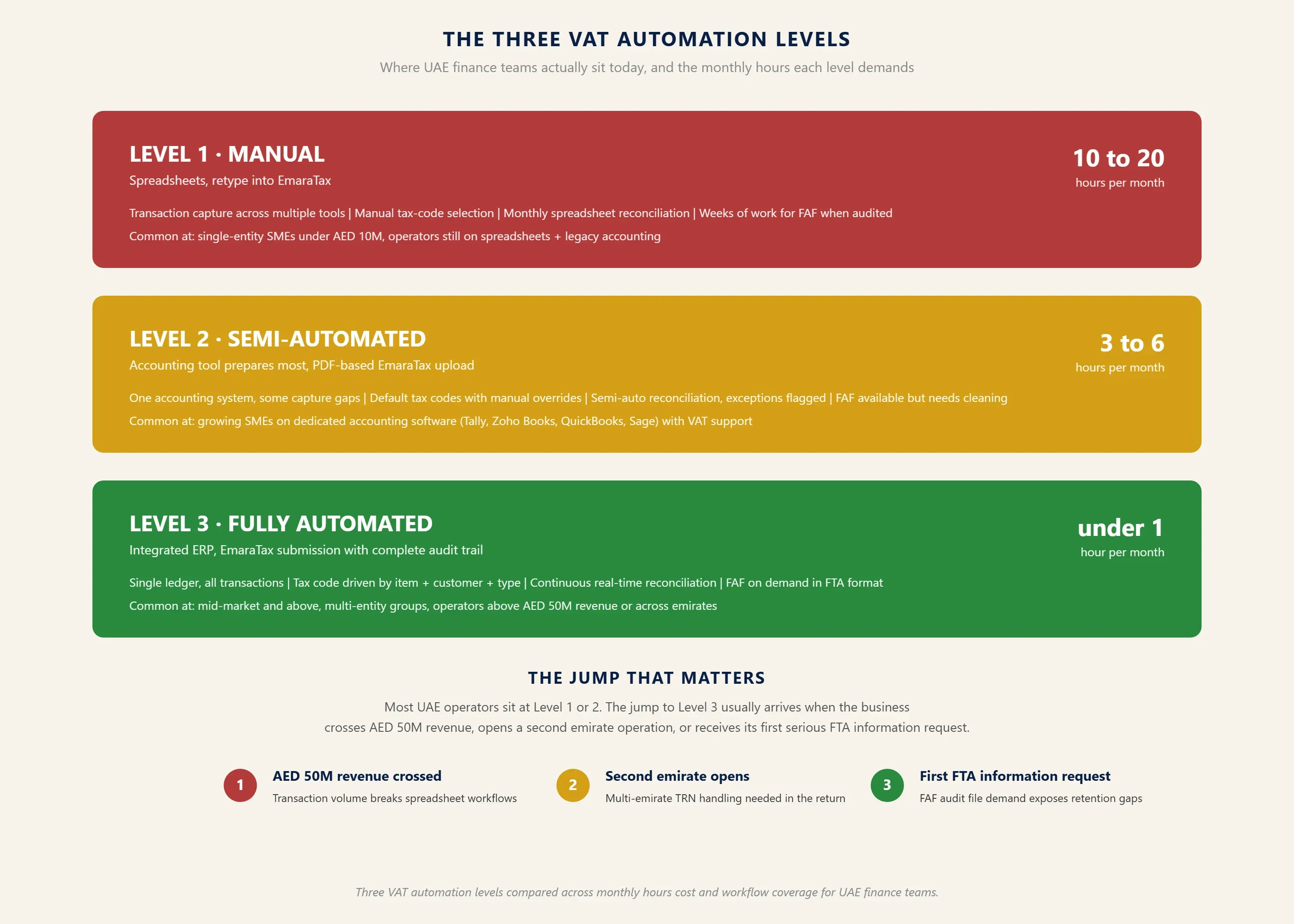
Most UAE SMEs sit at manual or semi-automated today. The jump from semi to fully automated typically comes when the business crosses either AED 50M revenue, opens a second emirate operation, or receives its first serious FTA information request. The automation gap is widest at month-end: a fully automated finance team closes VAT in a morning while a manual one burns most of the week.
UAE-specific VAT complexity your software must handle correctly
The UAE VAT regime is relatively simple on paper: 5% standard rate, limited zero-rated and exempt categories, quarterly or monthly returns. In practice, the complexity sits in the edge cases. A platform that handles 90% of transactions cleanly but fails on the other 10% creates the exact kind of exception work automation was supposed to eliminate.
Standard-rated, zero-rated, and exempt classification
Standard-rated covers most sales. Zero-rated covers specific categories: exports, international transport, certain educational and healthcare services, qualifying residential first supplies. Exempt covers residential leases (beyond the first supply), bare land, local passenger transport, and specified financial services. A tool that lets a user pick any code manually will produce misclassifications. A tool that drives the code from the item or service master will not.
Reverse charge VAT
Reverse charge applies to imports of goods and services, intra-GCC acquisitions from implementing states, and specified domestic supplies (gold, diamonds, certain hydrocarbons under specific rules). The accounting entry adds output VAT and input VAT in the same return in equal amounts, so the net impact is zero but the disclosure is mandatory. Missing a reverse charge entry is the single most common VAT return error for UAE operators, and the single hardest to spot post-filing.
Designated zones and free zone treatment
A designated zone is a specific type of free zone the Cabinet has designated for VAT purposes (JAFZA, DAFZA, KIZAD, and others). Supplies of goods between designated zones can be out of scope of VAT. Not every free zone is a designated zone. The software must treat the designated-zone flag as a distinct supply attribute, not conflate "free zone" with "VAT exempt."
Multi-emirate operations and TRN management
A business operating across Dubai, Abu Dhabi, Sharjah, and Northern Emirates may have one TRN serving multiple emirates, or separate TRNs. Return preparation needs to split standard-rated supplies by emirate for the VAT 201 disclosure. Software that keeps emirate as a transaction attribute, not a header-level field, handles this cleanly.
Partial exemption and apportionment
Operators making both taxable and exempt supplies (common in real estate, insurance, finance) can only recover input VAT in proportion to their taxable activity. The standard method is turnover-based; special methods require FTA agreement. The software must support at least standard apportionment natively and ideally handle direct attribution of input VAT where applicable.
Capital asset scheme
Capital goods above AED 5 million (land and buildings) and AED 500,000 (other capital goods) are subject to adjustment over 10 and 5 years respectively, if the taxable use of the asset changes. This is a long-tail requirement. Most SME operators will not hit it. Mid-market operators holding commercial property almost certainly will.
Seven criteria for evaluating VAT-compliant accounting software in UAE
Transaction coverage
Does the system capture every transaction type with VAT implications, or does it rely on a secondary tool for expense claims, imports, or inter-company? Gaps in capture undermine automation downstream. Ask the vendor to walk through a reverse-charge import, an inter-emirate transfer, and a designated-zone sale on their own screen.
FTA alignment and TRN validation
Does the system validate customer and supplier TRNs against the FTA database at invoice entry? Does it flag an invalid TRN before posting? TRN validation sounds like a hygiene feature. It is actually the first line of defence against inadvertent VAT recovery on bogus input invoices.
VAT 201 preparation depth
Which boxes does the system populate automatically, and which does your team still touch? A platform that preparers 85% of the return is useful. A platform that prepares 100% is the difference between a half-day close and a half-hour close.
FAF audit file generation
When the FTA asks for your audit file, how long does production take? A compliant platform generates the FAF in the FTA's prescribed format on demand. A non-compliant platform turns a 10-day FTA deadline into a crisis project.
Report completeness
Beyond the return itself, you need: input VAT by supplier, output VAT by customer, tax position summary, exception report (missing TRNs, misclassified items), and a continuous audit trail. If any of these require external build, your automation is incomplete.
EmaraTax integration path
Direct API integration with EmaraTax is best-in-class. Guided export (XML or PDF in EmaraTax's expected format) is standard-good. Manual retyping into the portal is standard-poor. Know which category your shortlisted software is in before signing.
Multi-entity consolidation
If you have multiple TRNs (separate legal entities, separate emirate registrations), the system must handle each TRN's return independently while consolidating at group level for management reporting. A single-entity architecture retrofitted for multi-entity usually produces reconciliation pain for groups with more than two TRNs.
Common VAT return mistakes automation prevents
The pattern we see most often across UAE operators moving from manual to automated workflows is that the same seven errors keep showing up in the first few returns. Automation does not eliminate every mistake. It eliminates the structural ones so the finance team's time goes into judgment calls instead of transcription.
| Mistake | Why it happens under manual workflows | How automation prevents it |
|---|---|---|
| Wrong tax code on an item | User picks from a drop-down per transaction | Code driven by item master and customer master |
| Missed reverse charge entry | Easy to forget on imports, invisible until audit | System detects import context and generates entry |
| Outdated or invalid TRN on an invoice | TRNs change, manual lists go stale | Live FTA TRN validation at invoice entry |
| Designated zone supply misclassified | Free zone and designated zone conflated | Designated-zone flag as a distinct supply attribute |
| Incomplete FAF when FTA audits | Documents scattered across tools and drives | FAF generated on demand in FTA format |
| Duplicate claim on input VAT | Same supplier invoice entered twice | Duplicate detection on supplier TRN plus invoice number |
| Late submission | Spreadsheet month-end runs long | Return ready in days, not weeks |

What VAT return automation costs vs saves (realistic UAE numbers)
For a mid-market UAE operator (AED 50M to AED 200M revenue, two to five entities, 20 to 100 staff), VAT-compliant accounting software sits in a predictable budget range. License runs AED 15,000 to AED 150,000 for the first year depending on scale and modules. Implementation adds 15 to 25 percent on top: data migration from spreadsheets or legacy accounting, chart-of-accounts configuration for FTA alignment, item-master cleanup, user training.
The savings side is less visible but larger over three years. A finance team spending 15 hours per month on manual VAT reconciliation represents roughly AED 40,000 to AED 60,000 in annual labour (assuming blended cost of a senior accountant plus a supporting role). Automation collapses that to under an hour per month. Add the risk reduction value of audit-readiness, the elimination of late-penalty exposure, and the opportunity cost reclaimed for actual analysis work, and the three-year payback typically lands between 12 and 18 months for mid-market operators.
The exception is very small operators (under AED 5M revenue, single entity). For them, a lightweight accounting tool with basic VAT support is usually enough. The automation case strengthens as scale, entity count, or compliance complexity grows.
Why we built Horizon EBS with VAT compliance as a core module
Horizon EBS has supported UAE businesses through the full VAT journey since the 2018 regime launch, with over 1,000 VAT implementations across the mid-market. We built VAT as a core module (not a bolt-on): automatic VAT calculation driven by item and customer masters, FTA-aligned TRN validation, VAT 201 return preparation with every box populated, FAF audit file generation on demand, complete input and output VAT reporting, and multi-entity consolidation across TRNs and emirates. The platform is backed by 35 years of UAE enterprise software experience since 1991, with in-house implementation consultants rather than reseller partners. If the seven criteria in this guide match what you need, the next step is to see Horizon EBS running on a dataset shaped like yours.
Next steps for UAE finance teams evaluating VAT software today
A structured evaluation sequence keeps a VAT-software decision on a 60 to 90 day timeline:
- Audit your current workflow. Count the hours your team spends on VAT reconciliation and VAT 201 preparation each month. That number is your baseline.
- Define your automation level target. Are you aiming for semi-automated or fully automated? The gap in scope and investment is significant.
- Shortlist three vendors. One UAE-native platform, one UAE-leading reseller of a global accounting tool, one dedicated VAT compliance tool. Three keeps comparison tractable.
- Score each vendor against the seven criteria. Weight the criteria by what matters most to your business (multi-entity for groups, FAF depth for high-audit-risk sectors, EmaraTax integration for scale).
- Request a demo on your own anonymised data. A vendor's dummy data cannot show how their software handles your transaction mix.
- Validate with a 30-day sandbox if the vendor offers one. Run a parallel VAT 201 preparation for one quarter against your existing process and compare.
- Budget realistically. 1.3x to 1.6x of quoted license for implementation and training. Build in a three-month ramp-up before fully retiring the old workflow.
The right platform is the one your finance team still prefers to the old spreadsheet in year three, not the one that demos best in week two.