
Before you file your first UAE Corporate Tax return, your ERP needs to be configured across 10 areas: chart of accounts alignment to CT categories, taxable-person setup, tax period and calendar, Small Business Relief tracking, Free Zone qualifying-income segregation, related-party transaction flagging, expense categorisation for deductibility, provisions and accruals classification, interest-deduction limitation tracking, and CT return generation. Getting these right at ERP setup avoids scrambling at year-end.
Why Corporate Tax + ERP is the biggest configuration question in 2026
UAE Corporate Tax took effect from 1 June 2023 under Federal Decree-Law 47 of 2022. Since the first full filing cycle in 2024-25, one pattern has become clear across UAE mid-market implementations: businesses whose ERPs were configured correctly at go-live filed their first CT return in hours. Businesses whose ERPs were configured only for VAT scrambled for weeks, produced returns from spreadsheets, and paid external tax advisors to reconcile positions the ERP should have surfaced automatically.
The gap is not about the tax rules themselves. It is about whether the ERP holds the right data at the right level of granularity to produce a CT return without manual intervention. This guide covers the 10 configuration areas UAE finance teams need to lock down before their next filing cycle.
The regulatory anchors your ERP must respect
Before the checklist, the regulatory framework your configuration decisions ladder up to:
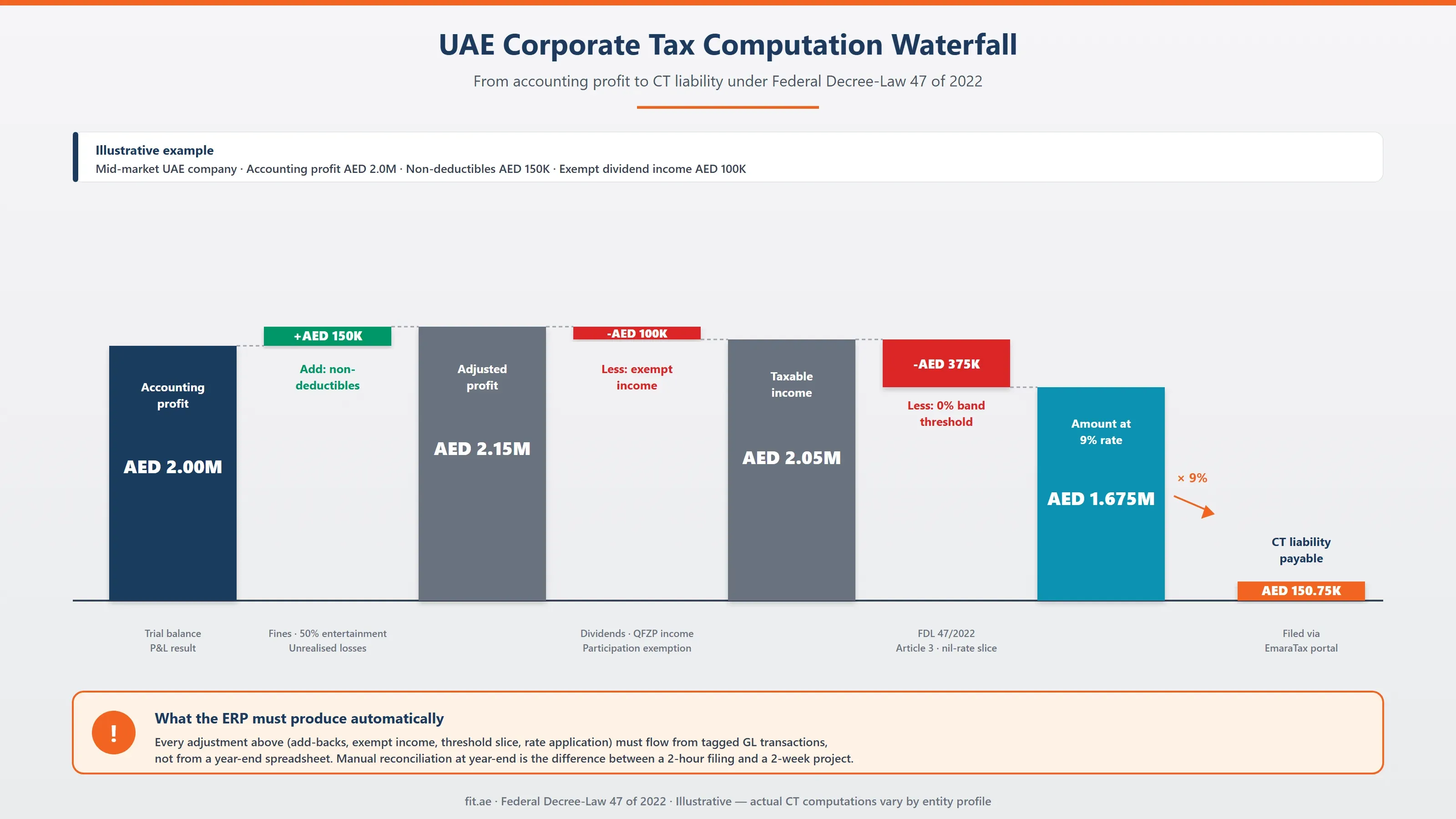
- Federal Decree-Law 47 of 2022: the Corporate Tax law itself, setting the 9 percent rate on taxable income above AED 375,000
- Cabinet Decisions 55 of 2023 and 100 of 2023: Free Zone qualifying income definitions
- Ministerial Decision 73 of 2023: Small Business Relief eligibility for businesses with revenue below AED 3 million
- Ministerial Decision 114 of 2023: Transfer pricing and connected persons
- IFRS accounting: the mandatory basis for taxable income calculation for most UAE entities
Each of the 10 configuration areas below traces back to at least one of these anchors. Your finance team should map the internal ERP setup document to these regulations so any auditor or tax authority reviewer can trace every configuration decision to the source rule.
The 10-item ERP configuration checklist
The checklist below groups into five clusters. Setup (items 1-3) covers the account and entity master data. Income tracking (items 4-5) covers the relief and qualifying-income elections. Transactions (items 6-7) covers the transaction-level flagging that drives CT adjustments. Compute (items 8-9) covers the calculation of provisions, interest, and their CT treatment. Return output (item 10) is the deliverable your ERP produces from all of the above.

1. Chart of accounts alignment to CT categories
Your chart of accounts must let you distinguish, at the account level, between revenue that is taxable, revenue that qualifies for exemption, expenses that are deductible, expenses with partial or no deductibility, and provisions that require year-end reversal. A chart of accounts designed only for management reporting will not surface CT positions automatically. Redesign the CoA with CT categorisation baked in, using account-level tags or a dedicated CT-treatment field on every account.
2. Taxable person setup
The ERP must hold your entity as a taxable person under Article 11 of Federal Decree-Law 47 of 2022, with the correct legal form, tax residency status, and registration reference. For groups, the ERP needs to distinguish between resident and non-resident persons, and between the head office and permanent establishments. Groups considering tax group election under Article 40 must be able to consolidate positions across entities while retaining entity-level detail.
3. Tax period and financial calendar
Your CT tax period follows your financial year (calendar or non-calendar). The ERP must enforce the correct tax period alignment across every transaction, generate period-end closing entries automatically, and support the 9-month filing window from period end. Businesses transitioning from a non-standard year-end to align with CT should model the transitional period carefully in the ERP master data.
4. Small Business Relief tracking
Under Ministerial Decision 73 of 2023, entities with revenue below AED 3 million per relevant tax period may elect Small Business Relief and pay zero CT. The ERP must track revenue at the taxable-person level in real time, flag when the AED 3 million threshold is approaching, and support the SBR election workflow at year-end. Businesses that expect to cross the threshold mid-year need clear visibility so treasury can plan for CT liability.
5. Free Zone qualifying-income segregation
Free Zone entities may qualify for 0 percent CT on qualifying income under Cabinet Decisions 55 of 2023 and 100 of 2023, subject to substance requirements and de minimis limits on non-qualifying income. The ERP must separate qualifying income from non-qualifying income at transaction level, track the de minimis ratio (5 percent or AED 5 million, whichever is lower) in real time, and support the qualifying-activity classification per Cabinet Decision guidance. Free Zone entities without this granularity default to the 9 percent standard rate.
6. Related-party transaction flagging
Article 34 and Ministerial Decision 114 of 2023 require related-party transactions to be at arm's length. The ERP must flag every transaction with a connected person at the point of posting, capture the transfer pricing method used, and produce a related-party transaction schedule for CT return purposes. Groups above threshold sizes must also produce a Master File and Local File; the ERP should hold the underlying transaction data these files draw from.
7. Expense categorisation for deductibility
Not every business expense is fully deductible under CT. Entertainment expenses are 50 percent deductible. Fines and penalties are non-deductible. Certain intra-group expenses have specific rules. The ERP must categorise every expense at posting time with the correct deductibility status, so the CT return generates the correct add-backs and adjustments automatically. Retrofitting deductibility categorisation at year-end is the single biggest source of manual reconciliation work.
8. Provisions and accruals classification
Provisions and accruals often require CT-specific treatment: some are deductible when accrued, some only when paid, and some require specific documentation to be deductible at all. The ERP must classify every provision at creation with its CT treatment, track the movement between provision and payment, and support the specific rules on employee benefits provisions, warranty provisions, and loan-loss provisions.
9. Interest-deduction limitation tracking
Under Article 30 of Federal Decree-Law 47 of 2022, the deduction of net interest expenditure is limited to 30 percent of adjusted EBITDA (with a de minimis threshold of AED 12 million). The ERP must track interest income and expense at the taxable-person level, produce adjusted EBITDA automatically, and calculate the current-year and carry-forward limitations. Groups with significant intra-group financing arrangements need particular care here.
10. CT return generation
The end deliverable: your ERP must generate a CT return from the general ledger without manual re-keying. That means holding a mapping of every GL line to the specific CT return field it feeds, producing the return computation from tagged transactions, retaining the audit trail for the statutory retention period, and supporting the FTA EmaraTax portal submission workflow. Businesses filing manually because their ERP does not generate the return spend 3 to 5 times longer on filing than businesses whose ERP handles it natively.
What NOT to try to do in your ERP
Some CT-related work belongs with your tax advisor, not inside the ERP configuration.
Interpretation of edge cases. The ERP should track what the transaction is; your tax advisor should tell you how a specific ambiguous case is treated for CT. Do not try to encode judgemental positions into the ERP configuration.
Free Zone qualifying-activity classification for novel business models. Cabinet Decision guidance covers the main qualifying activities; anything at the edge (new digital business models, hybrid trading-and-services arrangements) needs advisor input before you code the classification into the ERP.
Transfer pricing methodology selection. The ERP holds the transactions; the methodology (Comparable Uncontrolled Price, Resale Price, Cost Plus, Transactional Net Margin, Profit Split) is a technical tax decision requiring documented justification.
Reorganisation and restructuring positions. Group reorganisations, business combinations, and cross-border restructurings need advisor sign-off before ERP entries are made.
The ERP is a system of record for what happened. The tax advisor is a system of judgement for how what happened is treated. Do not blur the two.
How Horizon ERP handles the 10 checklist items
Horizon Enterprise Business Suite was built for UAE compliance from the ground up, which shows up specifically in the CT configuration layer:
- Chart of accounts template pre-configured with UAE CT categorisation tags on every account
- Taxable person master data with tax residency, legal form, and CT registration reference held natively
- Small Business Relief threshold tracking with real-time revenue accumulation and threshold-approach alerts
- Free Zone qualifying-income segregation with the de minimis ratio calculated on every posting
- Related-party transaction flagging with connected-persons register and arm's length method captured
- Expense deductibility rules embedded in the expense category master, so postings carry the correct treatment automatically
- Interest-deduction limitation calculation running in the background against the 30 percent EBITDA test
- CT return generation from the financial accounting module with the full audit trail retained
For UAE finance teams evaluating both their CT readiness and their ERP platform in parallel, our 8-question ERP buyer's framework walks through the wider evaluation criteria. The Dubai ERP software reference covers the broader compliance context including VAT, WPS, and e-invoicing.
Ready to pressure-test your ERP for Corporate Tax readiness?
Frontline Information Technology has spent 35 years implementing ERP for UAE mid-market businesses. Since Corporate Tax took effect in 2023, our team has walked hundreds of UAE finance leaders through the ERP configuration decisions that determine whether their first CT return takes hours or weeks. If you want a second opinion on where your ERP sits today against the 10-item checklist, our discovery call is designed to give you clarity, not a sales pitch.
Book a discovery call: fit.ae/enquiry
Speak to our team directly: +971 4 3533 727