
UAE businesses should upgrade from standalone accounting software (QuickBooks, Tally, Zoho Books, Xero, Sage) to a full ERP when they cross any of three thresholds: revenue above AED 50 million, more than one legal entity, or a month-end close that takes longer than 10 working days. Accounting software handles the ledger, invoices, and basic VAT. ERP adds the integrated data layer that accounting software cannot: multi-entity consolidation, inventory and procurement, project costing, HR and payroll under the same data model, and native Corporate Tax plus PINT AE readiness.
The upgrade decision is not primarily about cost (ERP typically runs 2 to 4 times accounting software in year one). It is about whether your current workflow can produce audit-ready Corporate Tax disclosures by September 2027 and PINT AE-compliant e-invoices by the 2027 SME deadline. This guide covers the 10 upgrade triggers, the realistic migration paths from the most common UAE accounting tools, and the decision framework that separates genuine upgrade cases from premature ones.
Why UAE SMBs are facing this decision right now
For most of the last decade, the "should we move from accounting software to ERP" conversation inside UAE SMBs could be postponed indefinitely. If VAT was being filed, the bank was reconciled, and the auditor signed off, the business carried on. Four shifts have changed that in the last 12 months.
Corporate Tax Year 1 is exposing what accounting software cannot do. The first Corporate Tax return for January-December fiscal year operators is due 30 September 2027. Finance teams running their first CT reconciliation on QuickBooks, Tally, or Zoho Books are discovering that these tools do not natively produce Corporate Tax-aligned revenue recognition, do not allocate costs across entities cleanly, and do not maintain the documentation trail an FTA audit expects. For many SMBs this is the first time accounting software has visibly failed a compliance task.
PINT AE Phase 2 is approaching. Phase 1 (large taxpayers) is already live. Phase 2 extends mandatory e-invoicing on the PINT AE standard to SMEs during 2027. Most SME accounting tools in UAE either do not have a PINT AE module, have it only as a paid add-on, or have no public implementation roadmap. ERP evaluation stops being optional when the compliance window closes.
SaaS accounting price hikes at renewal are narrowing the gap. A common UAE SMB complaint through the second half of 2026: Zoho Books, Tally cloud, QuickBooks Online, and Xero all quoting 20 to 40 percent year-on-year price increases at renewal. When the annual accounting software invoice crosses AED 40,000 for a 20-person operation, the gap to full ERP looks smaller than it did two years ago, and ERP comes with capability upside the accounting software cannot match.
Post-COVID growth is hitting the ceiling. Many UAE operators who tripled in size between 2020 and 2024 are now sitting at the 50-to-150 employee, two-to-three entity threshold where accounting software reliably breaks. The symptoms are identical across industries: the month-end close has crept from 4 days to 15, the finance team has hired two more people and is still behind, and the finance leader is quietly interviewing elsewhere.
If any of this sounds familiar, the upgrade decision is already live inside your business. The question is whether you make it this quarter or next.
What accounting software actually does (and what it stops doing at scale)
Accounting software is a focused tool. It does three things well and three things poorly.
What it does well. It records transactions into a general ledger. It produces invoices and tracks receivables. It files VAT returns with reasonable accuracy for single-entity businesses on cash or simple accrual accounting. For a UAE SMB under 20 people, single entity, no inventory, and limited project complexity, a VAT-ready accounting tool is often the correct choice.
Where it stops working. The first failure point is almost always multi-entity consolidation. Add a second trade licence, open a mainland entity alongside your free zone operation, or bring in a sister concern, and accounting software asks you to run two or three separate instances with no automatic consolidation. The finance team ends up exporting trial balances to Excel every month-end and matching them manually.
The second failure point is inventory at volume. Accounting software can track quantity on hand, but it does not do batch costing, serial tracking, multi-warehouse, retention management on construction stock, or bill of materials linking inventory to work orders. By the time a trading SMB crosses 500 SKUs or a construction SMB starts tracking retention releases, inventory lives in spreadsheets and the accounting software only sees the summary journal.
The third failure point is Corporate Tax readiness. CT disclosures require clean segregation of exempt vs non-exempt income, proper arm's-length transfer pricing documentation for related-party transactions, qualifying free zone person calculations, and the ability to tie every disclosed figure back to its source transaction. Accounting software can produce a P&L. It cannot natively produce a CT Year 1 disclosure pack that an FTA auditor can follow without supplementary workbooks.
If your team is spending two weeks each quarter bridging what the accounting software produces and what the regulation requires, the tool has stopped being an asset and started being a cost.
What ERP adds that accounting software cannot
ERP is not accounting software plus features. It is a different data architecture.
The core difference is a single data model across finance, inventory, procurement, HR, projects, and sales. A purchase order raised in procurement moves straight into inventory when goods are received, generates the accounts payable entry automatically, and allocates to the correct project cost code without a second data entry. Accounting software requires each of those events to be a separate transaction, often entered by a different person, often reconciled only at month-end.
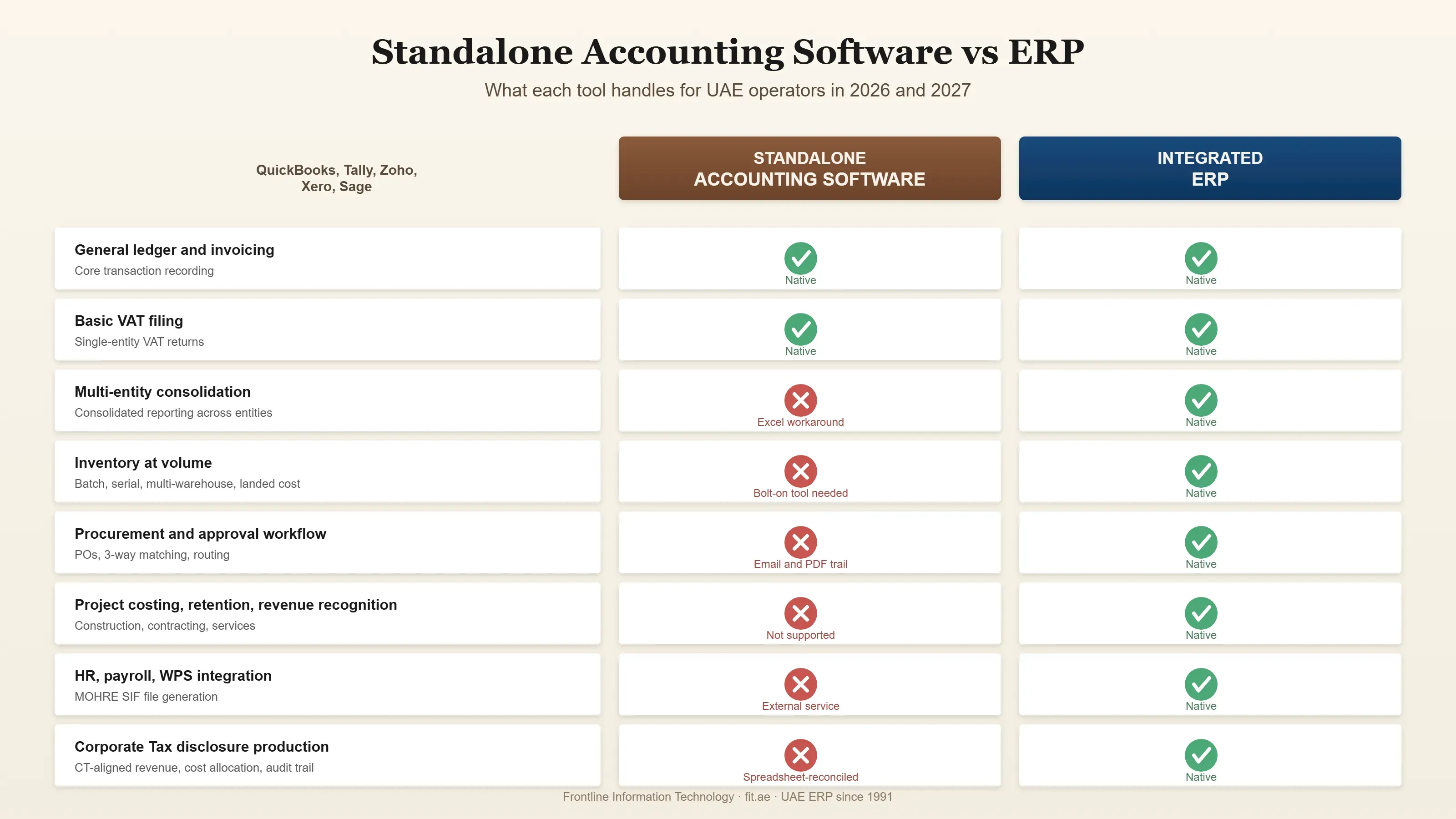
Practically, ERP gives a UAE SMB finance team seven capabilities that matter in 2026-2027:
- Multi-entity consolidation as a native function, not a spreadsheet exercise
- Corporate Tax disclosure production with traceable lineage back to source transactions
- PINT AE-compliant e-invoicing on a vendor roadmap tied to the UAE phasing timeline
- WPS-integrated payroll producing SIF files for MOHRE directly from the HR module
- Project costing with retention, revenue recognition, and margin visibility in real time
- Approval workflows across departments instead of email chains and PDF trails
- Executive reporting across the business instead of ad-hoc pivot tables
What the accounting software does for the ledger, ERP does for the business.
| Capability | Standalone accounting software | Integrated ERP |
|---|---|---|
| General ledger and invoicing | Native | Native |
| Basic single-entity VAT filing | Native | Native |
| Multi-entity consolidation | Excel workaround | Native |
| Inventory at volume (batch, serial, multi-warehouse) | Bolt-on tool needed | Native |
| Procurement with 3-way matching and approvals | Email and PDF trail | Native |
| Project costing, retention, revenue recognition | Not supported | Native |
| HR, payroll, WPS SIF file generation | External service | Native |
| Corporate Tax disclosure production with audit trail | Spreadsheet-reconciled | Native |
| PINT AE Phase 2 e-invoicing | No clear roadmap on most tools | Vendor roadmap tied to UAE phasing |
| Executive reporting across the business | Pivot tables and exports | Native dashboards |
The 10 upgrade triggers (decision framework)
Not every slow month-end is an ERP signal. These 10 triggers, scored honestly across your current operation, are the practical decision framework.
- Month-end close takes more than 10 working days. Clean close in a healthy SMB is 5 to 7 days. Over 10 is a workflow problem, not a staffing problem.
- Multi-entity reconciliation is done in Excel after export. If your consolidation lives in a workbook, you do not have consolidated numbers, you have a monthly best guess.
- Inventory is managed outside the accounting system. Separate inventory spreadsheet or a WMS that does not talk to finance means your cost of goods sold is reconstructed, not calculated.
- No native Corporate Tax module or PINT AE roadmap from vendor. If your accounting software vendor cannot show you a CT disclosure pack generator and a PINT AE implementation plan, you are heading into 2027 with compliance gaps.
- Finance team has grown to absorb reconciliation work. Red flag. You are paying people to patch the tool.
- VAT return reconciliation takes more than 2 days per quarter. Clean VAT off a well-configured system is a few hours of review.
- Three or more tools are involved in the month-end flow. Accounting software plus inventory sheet plus payroll service plus CRM plus retention tracker is five surfaces to reconcile.
- Bank reconciliation requires manual CSV export plus match. If your tool does not have live bank feeds or if the match rate is under 70 percent, you are wasting finance hours.
- Project profitability is unknown until after month-end. For construction, contracting, and professional services, this is a strategic blind spot.
- Executive reports take days to produce. If your MD waits three days for last month's segment P&L, the business is making decisions on stale data.
Score each trigger honestly. Zero to three triggers present: accounting software is probably still working. Four to six: upgrade is on the near horizon, start planning. Seven or more: the upgrade decision is overdue.

| Trigger count active | Severity | Recommended action |
|---|---|---|
| 0 to 3 | Accounting software still working | Stay on current tool. Revisit annually. Confirm vendor CT and PINT AE roadmap. |
| 4 to 6 | Upgrade on near horizon | Begin planning now. Build the FY2027 business case. Shortlist 3 vendors. Target go-live before CT Year 1 close. |
| 7 or more | Upgrade overdue | Decision needed this quarter. Running CT Year 1 close on current tool is a documented compliance risk. |
| Any 2 hard blockers (triggers 1-4 or 9) | Immediate action regardless of count | Hard blockers override low counts. Begin vendor shortlist within 30 days. |
Realistic migration paths from the most common UAE accounting tools
Migration is where upgrade plans fail or succeed. These are the realistic patterns we see on UAE accounting-to-ERP transitions.
From Tally. Typical 3 to 4 month migration. Data extraction is manageable (Tally exports to Excel cleanly). Common pain: historic VAT ledgers that were maintained outside Tally need to be reconciled before cutover. Teams coming off Tally often find the shift from entry-based workflow to approval-based workflow is the real adjustment, not the data move.
From QuickBooks Online. Typical 2 to 3 month migration. API-driven data extraction is clean. Common pain: multi-entity QuickBooks setups have usually been running as separate companies with no inter-company relationships configured, so chart of accounts normalisation takes most of the project.
From Zoho Books. Typical 2 to 3 month migration. Good API, clean exports. Common pain: Zoho's native inventory is light, so SMBs on Zoho Books plus Zoho Inventory usually find the ERP inventory model is a bigger change than the finance model.
From Xero. Typical 2 to 3 month migration. Clean data model, good export. Common pain: Xero add-on ecosystem means the business has often customised 3 to 5 add-ons that need to be collapsed back into native ERP modules.
From Sage 50 (desktop). Typical 3 to 4 month migration. Desktop data extraction is slower. Common pain: multi-user Sage setups often have workflow habits (year-end rollover, reporting conventions) that need to be unlearned on cloud ERP.
From Excel-primary. Typical 4 to 6 months, sometimes longer. Not because ERP is slow to configure but because the data cleanup is substantial. Businesses running primarily on Excel often have 3 to 5 versions of "the master sheet" and the ERP project becomes a data governance project first.
No UAE accounting-to-ERP migration should take more than 6 months for an SMB under 150 people. If a vendor quotes you 9 to 12 months, ask what else is in the scope.
| Source tool | Typical UAE timeline | Complexity | Primary cleanup effort |
|---|---|---|---|
| Tally | 3 to 4 months | Moderate | Historic VAT ledgers maintained outside Tally; workflow shift to approval-based |
| QuickBooks Online | 2 to 3 months | Low to moderate | Chart of accounts normalisation across multiple QBO companies |
| Zoho Books | 2 to 3 months | Moderate | Inventory model shift from Zoho Inventory to ERP native inventory |
| Xero | 2 to 3 months | Low to moderate | Collapsing 3-5 add-ons into native ERP modules |
| Sage 50 (desktop) | 3 to 4 months | Moderate to high | Desktop extraction, year-end habits, multi-user workflow retraining |
| Excel-primary | 4 to 6 months | High | Data governance project before ERP configuration starts |
Industry-specific context: when accounting software limits by vertical
The upgrade decision is sharper in some verticals than others.
Construction and contracting. Accounting software cannot handle job costing with real retention management, BoQ-linked procurement, or the multi-stage invoicing patterns (interim valuations, final accounts) that UAE construction runs on. Most UAE construction SMBs over AED 20M revenue are already running an inventory spreadsheet, a retention tracker, and a BoQ workbook alongside the accounting software. That is the pre-ERP state.
Real estate and property management. Mollak compliance, Ejari renewals, service charge calculation, lease accounting under IFRS 16, and multi-tower reporting are all outside accounting software scope. Property management SMBs typically run on accounting software plus 2 or 3 bolted-on tools.
Trading and distribution. Inventory at scale, serial and batch tracking, multi-warehouse, consignment stock, and container-level landed cost are all accounting software weaknesses. A distribution SMB with over 1,000 SKUs usually hits the ceiling early.
Manufacturing. Bill of materials, work orders, routing, shop floor, and production costing are all absent from accounting software. UAE manufacturing SMBs almost always start with ERP rather than accounting software for this reason.
Professional services. More nuanced. Simple time and billing can work on accounting software plus a time tracking add-on. Resource allocation, utilisation reporting, project margin by consultant, and multi-currency engagement accounting push the decision toward ERP.
If your industry made this list, the "when to upgrade" question is less about if and more about which year.
When accounting software is still the right answer
Not every UAE SMB should upgrade, and vendor marketing (including ours) often skips this point. The honest counter-case:
- Single entity, under AED 10M revenue, no inventory. A VAT-ready accounting tool plus a payroll service and a WPS workflow is adequate.
- Professional services firm with simple billing. Time tracking plus accounting software can carry you a long way.
- Early-stage startup pre-Series A. ERP is overhead you do not need before product-market fit.
- Franchise or branch operation. Head office runs ERP, branches run accounting software with scheduled upload. Common pattern in UAE retail.
- Owner-operator business. If you are the business and you know every transaction, simplicity beats capability.
The "stay on accounting software" decision is as valid as the "upgrade to ERP" decision, if you can articulate why.
What the upgrade decision actually costs
Headline cost difference between accounting software and ERP looks big on paper. The reality by year 3 is more nuanced.
Accounting software annual cost. AED 5,000 to AED 40,000 for the software and typical SME add-ons (bank feed, inventory add-on, payroll service). Finance team size tends to grow faster than revenue to absorb manual work.
ERP year 1 total. AED 60,000 to AED 500,000 depending on scope and scale. Breakdown covered in detail in our ERP implementation cost guide.
By year 3. Many SMBs find the TCO gap narrows considerably once you factor in the finance team size that accounting software requires to run reliably at scale, versus the leaner finance team an integrated ERP supports. The hidden cost of staying on accounting software is almost always the headcount growth needed to keep up with manual reconciliation.
There is also a compliance cost of not upgrading. Corporate Tax penalties for inaccurate disclosure, PINT AE non-compliance fines when Phase 2 goes live, and VAT reconciliation errors all have a real AED number attached.
How to approach the upgrade decision
A 3-step framework that keeps the decision out of the vendor pitch cycle.
Step 1. Score the 10 triggers honestly. Run the trigger list above with your finance team. Do not do this with a vendor in the room. The score should reflect the pain, not the pitch.
Step 2. Project forward 12 months. If your business plan involves growth, new entities, new products, or new geographies in the next 12 months, overlay those against the trigger list. Triggers compound. A business with 4 triggers today and strong growth usually has 7 triggers in 12 months.
Step 3. Build the 3-year TCO comparison. Accounting software plus the finance headcount it realistically requires at your projected scale, versus ERP plus the leaner finance team an integrated system supports. The number that matters is year-3 total cost, not year-1 licence cost.
If the TCO comparison still says "stay on accounting software", that is a valid decision. If it says "upgrade", the vendor evaluation is the next step, not the first.
How Horizon EBS handles the accounting-to-ERP transition
Horizon EBS is the ERP we have built and refined for the UAE market since 1991. In 35 years of UAE deployments, we have supported more SMBs through the accounting software exit than through any other migration path. The common journey: a UAE business on Tally, QuickBooks, Zoho Books, or legacy Sage runs into a Corporate Tax readiness conversation, scores the trigger list, and realises the upgrade is overdue.
Horizon EBS is modular by design. A typical accounting-to-Horizon transition starts with finance plus VAT plus Corporate Tax in month one, adds inventory and procurement in month two, and brings HR, payroll, and projects online in month three. No forced full-suite adoption in year one. The implementation team is UAE-based and available on local hours, which matters more than most SMBs realise until the first month-end close under the new system.
Next steps for UAE finance teams at the upgrade fork
A practical sequence for the finance leader who has decided to seriously evaluate the upgrade.
- Weeks 1 to 2. Score the 10 triggers with the finance team. Produce a 12-month forward projection. Share with the MD.
- Weeks 3 to 5. Shortlist 3 vendors. Request demos focused on your exact pain points, not generic feature walkthroughs.
- Weeks 6 to 8. Request a scoped proposal from top 2 vendors. Verify the migration timeline claim against the realistic patterns above.
- Week 9 onward. Decision and contract. Target go-live before Corporate Tax Year 1 close (Q1 2027 implementation start for September 2027 CT filing).
If the business targets a September 2027 CT filing from the new ERP, the decision needs to be made and the implementation started no later than end of Q1 2027. That timeline runs backwards from today.