
ERP implementation in UAE typically costs AED 80,000 to AED 500,000 in year one for mid-market operators, depending on business size, modules selected, and implementation partner tier. The breakdown is roughly 30 to 40 percent software license or subscription, 35 to 45 percent implementation services (data migration, configuration, training), 10 to 15 percent change management, and 10 to 15 percent ongoing support in year one. Timelines run 3 to 6 months for single-entity SMEs, 4 to 8 months for mid-market multi-entity operators, and 8 to 18 months for complex groups with heavy data migration or operations across multiple emirates.
This guide covers the 5-bucket cost breakdown, realistic AED ranges by business size, the 7 hidden costs most UAE buyers miss, implementation timeline reality, and how to evaluate implementation partners in a market where vendor pricing varies by 3 to 5x for the exact same scope. Written for UAE CFOs, finance directors, and operations leads building the ERP business case in the 2026-2027 budget cycle.
Why UAE businesses are budgeting for ERP right now
ERP is always on the buyer agenda somewhere, but four 2026-2027 forces are compressing the decision timeline for UAE operators who were hoping to postpone.
UAE Corporate Tax Year 1 filings are approaching. The first Corporate Tax return is due September 2027 for operators on a January-to-December fiscal year. Finance teams running the numbers right now are realising that manual accounting plus spreadsheet reconciliation does not produce audit-ready Corporate Tax disclosures at scale. The 9 percent tax above the AED 375,000 threshold requires clean revenue recognition, clean cost allocation across entities, and documented support. ERP evaluation has become a compliance-driven budget item on many CFO desks this quarter.
FY2027 budget cycle is locking. November is when most UAE businesses finalise next year's technology spend. ERP is a line item that needs an actual AED number to make the budget, not a vague "software investment" placeholder. Buyers who do not land on a vendor in November typically slip to a mid-year 2027 go-live, which puts them in Corporate Tax Year 1 close without the system in place.
GITEX Global Dubai had 20+ ERP vendors on the show floor in October 2026. Oracle, SAP, Microsoft, Zoho, Odoo, Tally, Sage, and every GCC-native vendor pitched the UAE SMB market. Operators who took those meetings are now in cost-research and shortlist phase. The question moves from "do we need ERP" to "what does it actually cost and who do we trust to implement it."
PINT AE e-invoicing Phase 2 approaches. Phase 1 (large taxpayers) is live. Phase 2 extends the mandate to SMEs during 2027. Businesses on QuickBooks, Tally, or Sage in 2026 are increasingly realising their accounting tool does not have a credible PINT AE roadmap. The compliance deadline forces an ERP decision whether the operator was planning one or not.
The convergence of these four forces explains why ERP inquiries are up across the UAE market this quarter. The teams getting ahead are the ones with realistic AED numbers in the FY2027 budget right now.
The 5-bucket breakdown of UAE ERP implementation cost
Vendor quotes make cost comparison difficult because each vendor slices the total differently. Breaking the full year-one investment into 5 buckets lets you compare apples to apples across proposals.
| Bucket | What it covers | Typical % of year-1 budget | Where buyers get surprised |
|---|---|---|---|
| Software license or subscription | Named users, modules selected, deployment model (cloud or on-premise) | 30 to 40% | Per-user pricing scales fast as team grows year 2+ |
| Implementation services | Data migration, configuration, UAE compliance setup, user training, UAT support | 35 to 45% | Data migration from dirty legacy systems adds 15-25% |
| Change management | Process re-engineering, user communication, superuser enablement, post-launch coaching | 10 to 15% | Routinely under-budgeted; failed implementations often skip this |
| Infrastructure (on-premise only) | Server, network, backup, disaster recovery, hardware refresh in year 3 | Variable (0% for cloud) | Year 3 hardware refresh is a separate capex event |
| Ongoing support and maintenance | Issue resolution SLA, monthly health checks, minor customisation, upgrade coverage | 10 to 15% in year 1, then recurring | Offshore support tiers are often badged as UAE support |
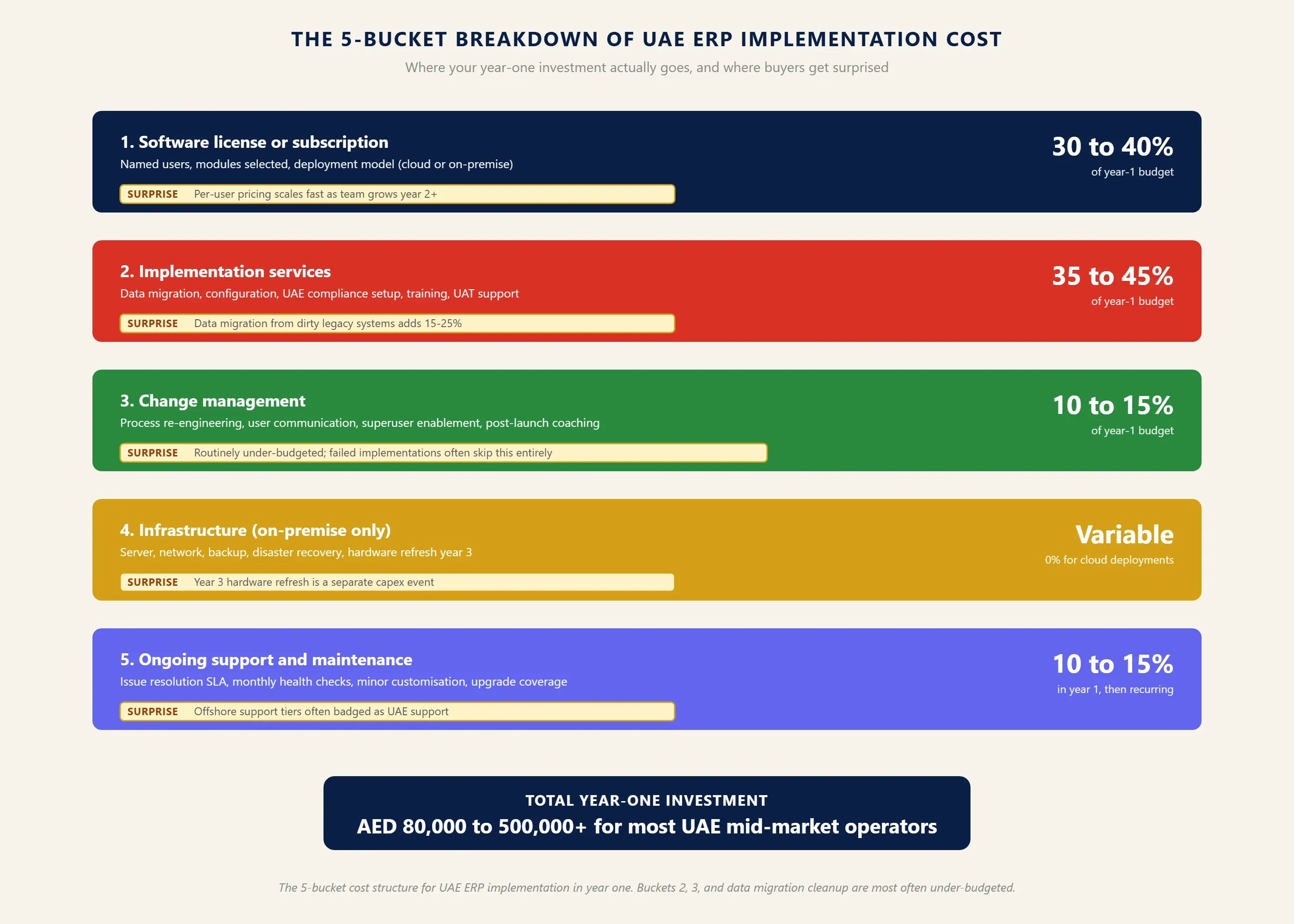
The three buckets most buyers under-budget are change management, data migration (which sits inside implementation services), and ongoing support. Skimping on any of them does not reduce year-one cost by much, but it meaningfully increases the probability of a failed or stalled rollout.
Realistic AED ranges by business size
ERP cost tracks closely to business size, entity count, and module complexity. The ranges below are what we see consistently across UAE mid-market deployments.
| Business size | Year-1 AED range | Typical timeline | Modules usually in scope | Entity count |
|---|---|---|---|---|
| Small SME (under AED 10M revenue) | AED 60,000 to 150,000 | 3 to 5 months | Financial accounting, basic inventory, VAT, HRMS lite | 1 entity |
| Growing SME (AED 10M to 50M) | AED 120,000 to 280,000 | 4 to 6 months | Finance, procurement, inventory, sales, HRMS, VAT, Corporate Tax | 1 to 2 entities |
| Mid-market (AED 50M to 200M) | AED 250,000 to 500,000 | 5 to 8 months | Full finance, procurement, inventory, sales, HRMS, FM or PM, VAT, Corporate Tax, PINT AE | 2 to 5 entities |
| Large mid-market (AED 200M to 500M) | AED 500,000 to 1,000,000 | 8 to 12 months | Full ERP plus industry modules (construction, real estate, FM) | 3 to 8 entities |
| Enterprise (AED 500M+) | AED 1,000,000 to 2,000,000+ | 12 to 18 months | Full ERP plus custom modules, deep integrations, multi-emirate, multi-currency | 5+ entities |
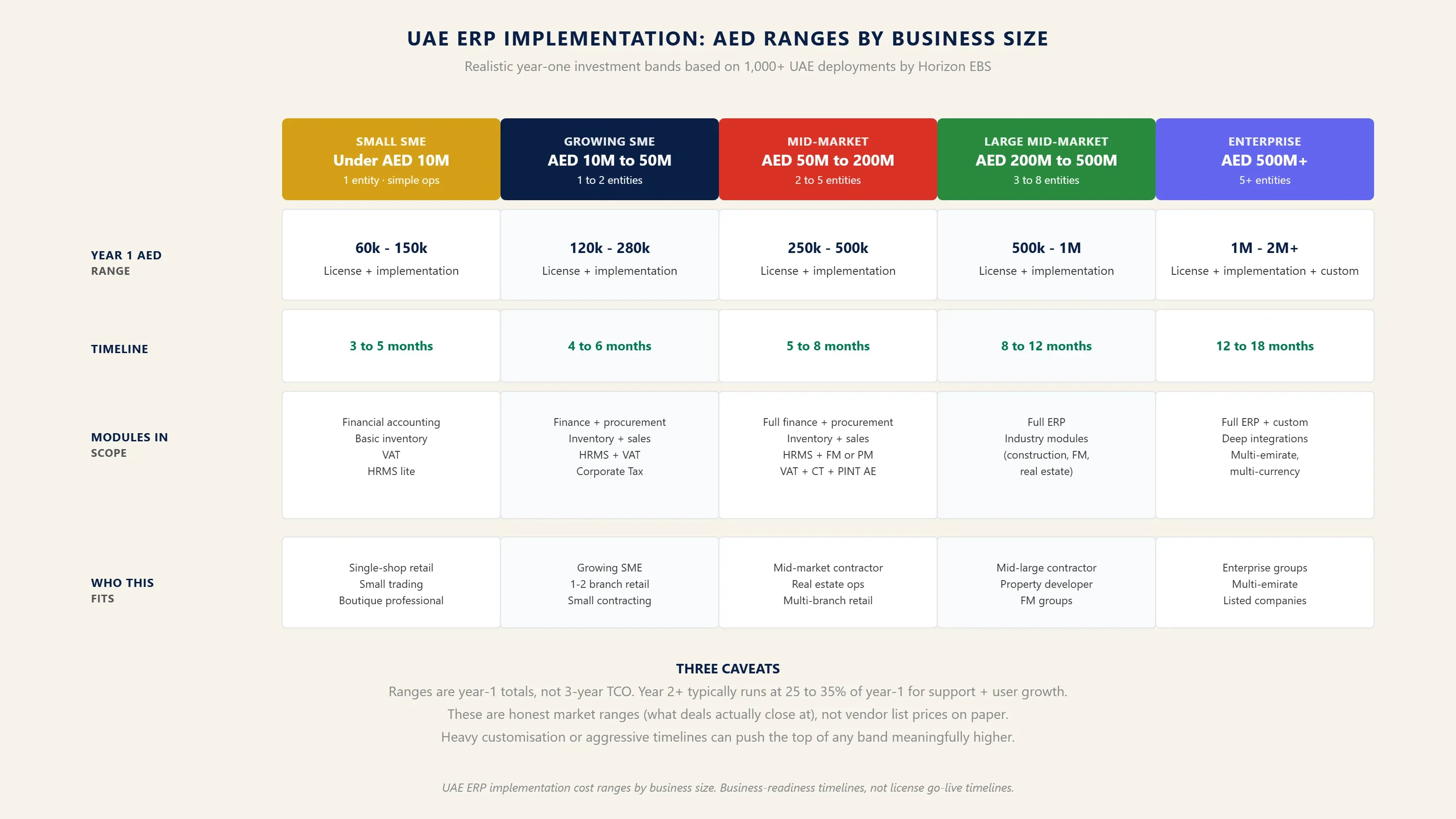
Three caveats to the ranges. First, these are year-one investment totals, not three-year TCO (total cost of ownership). Year 2 and year 3 drop to roughly 25-35 percent of year-one investment for ongoing support and additional user licenses. Second, these are honest market ranges, not vendor list prices. Vendor list prices on paper can be 2x higher, but negotiated UAE deals typically land in these bands. Third, heavy customisation or atypical complexity (unusual integrations, aggressive timelines, acquisition migration) can push the top of the range significantly higher.
What's included vs charged extra in UAE vendor contracts
The single biggest reason vendor quotes look so different for the same scope is that each vendor includes different items in the base number and bills others as add-ons. Know the pattern before you sign.
Typically in the base quote:
- Named user licenses for year 1
- Core modules selected at contract (finance, sales, inventory)
- Standard implementation services (data migration, configuration, training)
- Go-live support for the first 30 days
- Access to the standard knowledge base and ticketing
Typically charged extra (and legitimately so):
- Additional modules added mid-project
- Custom reports beyond the standard set
- API integrations with third-party tools (bank feeds, Mollak, Ejari, CRM)
- Data migration from more than one legacy source
- Change requests to the standard chart of accounts
- Training sessions beyond the agreed quota
Typically charged extra when they should not be (vendor pricing red flags):
- VAT or Corporate Tax module as a separate SKU (UAE-native ERP should bundle)
- PINT AE e-invoicing compatibility as a paid add-on
- "UAE localisation" fee on top of the base license
- Support SLA above basic (if the base SLA has no response time commitment)
- Named-user licenses that do not cover management reporting
UAE-specific extras you should legitimately budget for on top of the base quote:
- Corporate Tax readiness configuration (if not in base, usually 15-25k AED)
- PINT AE compatibility (if not bundled, usually 20-40k)
- WPS payroll integration if using the HRMS module
- Bank feed setup for primary banks (ADCB, Emirates NBD, FAB, HSBC, Mashreq typically free; smaller banks sometimes paid)
- Mollak or Ejari integration for real estate operators
The 7 hidden costs most UAE buyers miss
These are the costs that do not appear in the sales deck but reliably show up in year-one invoices. Every one of them is budgetable if you know to ask.
1. Data migration cleanup (15 to 25 percent add-on if legacy data is dirty). If your current accounting system has 5 years of inconsistent customer records, duplicate vendor masters, or TRN fields filled inconsistently, the cost of cleaning that data to load into the new ERP is real work. Vendors typically quote the migration assuming clean source data. The cleanup, if needed, is extra.
2. UAE compliance module upcharges. As noted above, some vendors treat Corporate Tax, VAT, PINT AE, and WPS as separate paid modules. For a UAE operator, these are not optional, so the "lower license cost" is often erased by the compliance add-ons.
3. Additional user licenses year 2 and onward. Most vendors price per named user. Your team grows, your user count grows, and the year-2 renewal is often 20-40 percent higher than year 1. Factor this into the 3-year TCO before signing.
4. Integration costs beyond the base. Bank feeds, Mollak, Ejari, your existing CRM, your custom pricing engine, your field service app. Each integration is a project. The vendor may include two or three in the base, but a mid-market operator typically has 6 to 10 integrations to wire up.
5. Offshore support premiums. Vendors with no in-house UAE team often route support to India, the Philippines, or Eastern Europe. That is fine if it works. It is not fine if you are paying UAE rates for an offshore SLA. Confirm where the support team actually sits before signing.
6. The 6-month refresher training. Almost every rollout skips this. Six months after go-live, user confidence has drifted, workarounds have accumulated, and the superusers have left for other projects. A short refresher at month 6 pays for itself three times over in reduced support tickets, but almost no quote includes it.
7. Infrastructure scaling in year 2 or 3. If on-premise, your server will need upgrading. If cloud, your storage and user count will grow. Either way, there is a year-2 or year-3 infrastructure event that does not show up in the year-1 quote.
Implementation timeline reality
The vendor sales cycle creates pressure to quote aggressive timelines. The reality in UAE deployments looks different.
| Complexity band | Timeline range | What gets done | Common blocker categories |
|---|---|---|---|
| Single-entity SME, standard modules | 3 to 5 months | Requirements, config, data migration from one source, 2 training waves, UAT, go-live | User availability for training; dirty source data |
| Multi-entity mid-market | 5 to 8 months | Multi-entity chart of accounts, inter-company flows, 2-3 integrations, 3 training waves, phased go-live | Entity-level process variance; signing-authority delays |
| Complex group with industry modules | 8 to 12 months | Multi-emirate, multi-currency, 5+ integrations, custom reporting, parallel-run for 1 quarter | Legacy data complexity; vendor dependency chains |
| Enterprise multi-emirate with customisation | 12 to 18 months | Full custom build, complex integrations, phased rollout by business unit, extended parallel-run | Change management; executive attention; scope creep |
The pattern we see most often in UAE deployments is that mid-market operators think they are a 3-month project (vendor marketing) but turn out to be a 6-month project (reality). The 3-month quote almost always refers to license go-live, which means you have the software installed and users logged in. It does not mean month-end close runs on the new system, Corporate Tax reporting is configured, or WPS SIF generation works cleanly. Business readiness, which is what matters, typically takes twice the quoted timeline.
Red flags in UAE ERP vendor pricing
A clean vendor quote is not the one with the lowest number. It is the one with the fewest surprises in year 2 and 3. Watch for these patterns.
"License-only" quotes that hide implementation cost. Some vendors lead with a low license number and quote implementation separately at a day-rate. The total can be 2-3x the implied figure. Always ask for a fully loaded year-1 total.
Per-user pricing that does not scale predictably. Per-user looks cheap when you have 20 users. At 80 users in year 2, the arithmetic can hurt. Ask for the year-2 and year-3 price projection assuming realistic user growth, not the year-1 number only.
"90 percent of features included" without naming the missing 10 percent. The missing 10 percent is where the extra invoices come from. Insist on a line-item feature matrix with "included," "optional," and "custom" clearly marked.
Offshore teams badged as UAE support. A WhatsApp number with a +971 prefix does not mean the engineer answering is in the UAE. Ask for the physical address of the support team and the names of your implementation consultants.
Contracts with no data-export guarantee. If you ever want to switch vendors, you need your data back in a usable format. Contracts that do not commit to a specific export format are a lock-in red flag.
Flat monthly fees that balloon in year 2. Some cloud ERPs introduce year-2 price escalation clauses that are easy to miss. Read the renewal terms before signing, not after.
How to choose an ERP implementation partner in UAE
The partner matters more than the software for most mid-market deployments. A great partner can rescue a mediocre software choice; a poor partner can wreck a best-in-class one.
UAE presence that is in-house, not reseller. In-house teams carry their own knowledge, stay with the project, and have skin in the game on the outcome. Reseller teams rotate, are compensated on licenses sold rather than deployments delivered, and have thinner escalation paths.
Industry match. Construction, real estate, FM, trading, and manufacturing each have specific requirements. A partner with 10 UAE construction deployments under their belt will deliver faster for a contractor than one who is doing their second-ever construction project.
Compliance depth, not compliance claims. Ask for a live screen-share of a Corporate Tax configuration, a PINT AE e-invoicing demo, and a WPS SIF generation on dummy data. The partners who can do all three without preparation are the partners who know what they are doing.
UAE reference customers in your vertical and emirate. Two references in your specific shape beat ten generic ones. A FM operator in Abu Dhabi learns more from a FM-vertical Abu Dhabi reference than from a construction-in-Dubai reference, however well regarded.
The big-firm vs boutique trade-off. Big firms (Deloitte, PwC, EY, KPMG) bring scale, methodology, and a brand name that reassures boards. Boutique UAE firms bring deeper hands-on expertise, lower cost, and more flexibility. For mid-market operators under AED 200M, boutique UAE firms typically deliver better outcomes per dirham spent. For large enterprise and multi-geography groups, big firms earn their fee. Choose the right tool for the right scope.
The 90-day evaluation sequence for UAE buyers
Most ERP decisions take 6-9 months when done loosely. They can be done in 90 days when done tightly.
- Weeks 1-2: Requirements. Document your must-haves, nice-to-haves, and explicit non-requirements. Involve finance, operations, IT, and one business-unit head. One page per function.
- Weeks 3-4: Shortlist 4-5 vendors. One UAE-native, one UAE reseller of a global product, one direct-global, one niche-vertical. Request a one-hour intro call, not a demo.
- Weeks 5-7: Scored demos. 2-hour demo per vendor on your own anonymised data. Score against your requirements document. No vendor should get a second meeting without scoring.
- Weeks 8-9: References. Three references per shortlisted vendor, ideally in your vertical and emirate. 30 minutes each. Ask about surprises and regret, not marketing.
- Weeks 10-11: Sandbox or paid proof-of-concept. The top 2 vendors run a 30-day sandbox on your real workflow. Pay if required. This is cheap insurance.
- Week 12: Contract and SOW. Legal review, SLA sign-off, data-export clause, pricing confirmation across years 1-3, kickoff date.
- Kickoff. The actual implementation begins. Everything before this point was due diligence that pays itself back 10x in reduced rework.
Operators who follow this sequence consistently report the lowest surprise rate post-go-live. The ones who skip the sandbox step consistently report the most.
Why we built Horizon EBS implementation to be predictable
Horizon EBS has run over 1,000 UAE implementations across SMEs through large enterprise groups since 1991. We publish realistic AED ranges before engagement because UAE operators have told us for 35 years that their single biggest frustration with ERP vendors is quote volatility. Our implementation team is in-house (not reseller), Corporate Tax and PINT AE readiness are bundled with the core modules, and we scope projects to business-readiness milestones rather than license go-live markers. The result is that Horizon implementations land within 10 percent of initial AED estimate and within one month of planned timeline for the majority of mid-market deployments.
Next steps for UAE finance teams building the ERP business case
If you are building the FY2027 ERP line item this month, a structured 3-week sequence closes the gap from "we should look at this" to "we have a defensible number in the budget."
Week 1: Internal alignment. Get the CFO, COO, and IT lead in one room for an hour. Agree on scope (which modules, which entities, which users) and timeline target (go-live before Corporate Tax Year 1 close means Q2 2027 at the latest).
Week 2: Market scan. Pull AED ranges from this guide, 3-5 vendor web pages, and at least one peer operator's actual experience if your network allows. Validate your internal expectation against market reality.
Week 3: Business case document. One page: current-state cost (manual effort, compliance risk, system patch budget), year-1 ERP investment, 3-year TCO, payback timeline, strategic rationale (Corporate Tax readiness, PINT AE compliance, growth enablement). Present to the board or finance committee.
The teams that do this in November typically close vendor selection by end of Q1 2027 and are live before year-end Corporate Tax filing. The teams that start in January often end up filing their first Corporate Tax return without the ERP in place, which is exactly the scenario the whole exercise was supposed to prevent.