
Property management software in Dubai handles leasing, tenancy, rent collection, maintenance, and compliance for UAE real estate operators. The right choice depends on your portfolio type, your regulatory stack (Mollak, Ejari, DLD, VAT, Corporate Tax), and whether you need standalone property management or a full real estate ERP integrated with finance. This guide walks UAE developers, property managers, and FM-first operators through the seven criteria that actually determine fit, before the demo and before the shortlist.
The 2026 buyer's reality is that the UAE market has roughly 40 vendors competing for mid-market attention, most of them resellers of global products with partner-added compliance layers. A handful of UAE-native platforms carry the regulatory stack as core modules. This guide is written to help you tell the difference without sitting through five demos first.
What is property management software, and how it differs from real estate ERP
Property management software handles the leasing lifecycle: tenant onboarding, lease creation, rent collection, renewals, cancellations, maintenance requests, and basic reporting. It is a specialist tool, usually sold per unit or per property. Most UAE operators under 200 units start here, often migrating from spreadsheets and WhatsApp.
A real estate ERP covers all of that plus finance (accounts receivable, accounts payable, general ledger, financial reporting), procurement, HR and payroll, fixed assets, and procurement, all sharing a single chart of accounts. Horizon EBS is an example of a real estate ERP: the Real Estate module runs the leasing cycle, but it writes to the same ledger as the Financial Accounting module, the Fixed Assets module, and the HRMS module.
The practical difference shows up at scale. If your portfolio is above 200 units, or you have more than one legal entity (developer plus FM arm plus leasing arm), or your finance team is reconciling three systems by month-end, you are almost certainly in ERP territory. If you manage a single tower or a small residential book, standalone property management software may be enough.
The deciding question is not "what does my leasing team need." It is "where does the data have to go next."
Why UAE property managers cannot use off-the-shelf global software
The UAE regulatory stack is specific, dense, and changes often. A property management platform that works in Austin, Melbourne, or Manchester usually cannot be used in Dubai without local partners filling the gaps. The gaps are:
- Mollak. The Real Estate Regulatory Agency's platform for service charge collection on Dubai jointly-owned properties. Every service-charge invoice issued to a unit owner must flow through Mollak, with specific calculation rules.
- Ejari. The Dubai tenancy registration system. Every residential and most commercial tenancies in Dubai must be registered on Ejari within a specific window.
- DLD and Oqood. The Dubai Land Department's portals for title registration and off-plan sales tracking.
- VAT. The 5% VAT regime, with different treatment for residential (generally exempt or zero-rated depending on the contract) versus commercial (standard rated), different treatment for owners' association service charges, and VAT recovery rules on operating expenses.
- Corporate Tax. The 9% federal Corporate Tax regime, in force since 2023, with implications for how rental revenue is recognised, how depreciation is handled on investment property, and how losses are carried forward.
- PINT AE e-invoicing. The federal e-invoicing standard, with large taxpayers in scope from 2026 and remaining phases rolling through 2027. Commercial lease invoices will fall under this.
Global vendors sell into their largest markets first (US, UK, EU, Australia). Building Mollak, Ejari, DLD connectivity, VAT, Corporate Tax, and PINT AE natively does not pay off for them, so they offload to local partners. The partner model works when the partner is a stable implementation shop with its own development team. It fails when the partner is a reseller holding a single-page integration spec.
Local legacy point tools often cover one or two of these regulations well but rarely integrate with finance. Operators who have been stitching together a lease management tool, a cheque management tool, a Mollak tool, and QuickBooks for seven years know the pain already. The architecture question is simple: do you want five point tools talking by CSV export, or one integrated platform?
Property management software vs real estate ERP vs CAFM
The three categories overlap more than vendors admit. A quick comparison across the dimensions that decide fit for a UAE operator:
| Dimension | Property Management Software | Real Estate ERP | CAFM |
|---|---|---|---|
| Primary user | Leasing and tenancy teams | CFO, COO, whole business | FM manager and technicians |
| Scope | Lease cycle and rent collection | PMS plus finance, HR, procurement, assets | Maintenance, assets, work orders |
| Finance integration | Partial (export to accounting) | Native (shared chart of accounts) | Partial (cost export only) |
| UAE compliance depth | Depends on vendor and partners | Core module in UAE-native ERPs | Rarely addressed |
| Fit for 500+ unit portfolios | Marginal | Strong | FM-only |
| Fit for developer + leasing + FM | Weak | Strong | Weak |
| Typical AED year-one investment | 50k to 150k | 150k to 500k | 80k to 200k |
Where you sit on this grid is a function of your portfolio size, your organisational complexity, and your finance team's tolerance for CSV exports between tools. If you have one tower, one accounting system, and one leasing manager, you can live in the first column. If you have five entities, a mixed-use book, and a monthly MIS pack to produce, you are in the second.
The third column exists because facility management operators sometimes buy CAFM thinking it will do leasing. It will not. If you want both FM and leasing in one platform, a real estate ERP with an integrated FM module is the right shape, not CAFM.
The seven criteria that decide fit for UAE operators
Mollak and service charge accuracy
Mollak is non-optional for Dubai jointly-owned properties. The question is depth. A UAE-fit platform does three things with Mollak: it calculates service charge by unit per the approved community budget, it generates the Mollak invoice in the expected format with the owner's name and unit reference, and it reconciles collection back to the ledger. A weak platform does the first and asks you to retype the second two into Mollak's portal.
Ask the vendor for a screen-share of a real Mollak submission end-to-end on dummy data. If the demo cuts away before the submission step, assume the integration is manual.
Ejari and tenancy registration depth
Ejari registration must happen within a specific window after lease signing. UAE-fit property software stores the Ejari certificate against the tenancy, prompts the leasing team to upload the submission receipt, and surfaces an alert when registration is overdue. More advanced platforms submit directly to Ejari via API.
The red flag here is a platform that treats Ejari as a document attachment with no workflow around it. For small portfolios that works. At 500 units it stops working.
VAT, Corporate Tax, and PINT AE e-invoicing readiness
VAT revenue recognition for leasing is more nuanced than it looks. A twelve-month commercial lease with monthly rent and a one-off deposit has different VAT treatment on each component. A platform that posts the full annual rent as VATable on day one is wrong. The right behaviour is monthly recognition against the service period.
Corporate Tax readiness means two things: the chart of accounts separates leasing revenue, maintenance income, and other income so taxable base is clean, and the system supports FTA-aligned reporting. PINT AE readiness means the vendor has a published roadmap for the e-invoicing phases, not a vague "we are compliant."
Post-dated cheque and PDC management
The UAE still runs on cheques. Any platform claiming to work in this market without native PDC handling (presentation dates, bounce tracking, replacement cheque workflow, cheque-book exhaustion alerts, and bank reconciliation) is a non-starter for operators collecting rent monthly.
Ask the vendor what happens when a tenant replaces a bounced cheque. If the answer involves a manual journal, keep looking.
Service charge and maintenance cost allocation per unit
Operators with mixed-use portfolios need maintenance cost allocation at the unit level, not the property level. If a chiller services units 101 to 304, the maintenance cost of that chiller must be allocated across those units by a defined rule (floor area, usage, or equal share). A platform that only tracks maintenance at the property level will cost you accuracy on your service charge calculations and on your tax deductibility position.
Scale handling
Property management software was built for the first 200 units. Real estate ERPs are built for the next 2,000. Scale breaks show up in month-end batch processing time, in report rendering, and in the number of concurrent users the platform can hold. If your portfolio will double in three years, factor that into the demo. Ask to see the platform running on a 2,000-unit dataset, not a 50-unit sample.
UAE support footprint
A "UAE office" that is a reseller holding one copy of the manual is not a support footprint. In-house implementation consultants, product engineers reachable within one time zone, and local case history across your property type are what you actually need. Resellers rotate; in-house teams stay.
Ask for a named implementation consultant, their LinkedIn, and two UAE references in your property type.
Vertical fit: different property types need different capabilities
The seven criteria above decide whether a platform is UAE-fit at all. Vertical fit decides whether it is right for your specific portfolio. The gap between a residential-developer-first product and a commercial-leasing-first product is wider than most vendors suggest.
| Vertical | Critical capability | Where generic platforms fall short |
|---|---|---|
| Residential developers | SPA plus payment-plan tracking, Oqood submission, milestone invoicing | Treat off-plan sales as one-time transactions, no plan tracking |
| Commercial and office portfolios | Lease escalation, renewal workflow, parking allocation | Flat lease model with no escalation logic |
| Mixed-use and retail | Common area service charge split, footfall data integration | Property-level allocation only, no unit-level breakdown |
| Industrial and warehouse | Long leases, security deposits, utility sub-metering | No sub-metering, deposits treated as revenue |
| Owners associations | RERA-compliant service charge, reserve fund accounting | Service charge treated as rent, no reserve fund logic |
| Hotel and serviced apartments | Occupancy, nightly rates, daily cost base | Monthly rent model only |
| FM-first operators | Preventive maintenance, technician dispatch, SLA tracking | FM is a tagged-on module, not a core workflow |
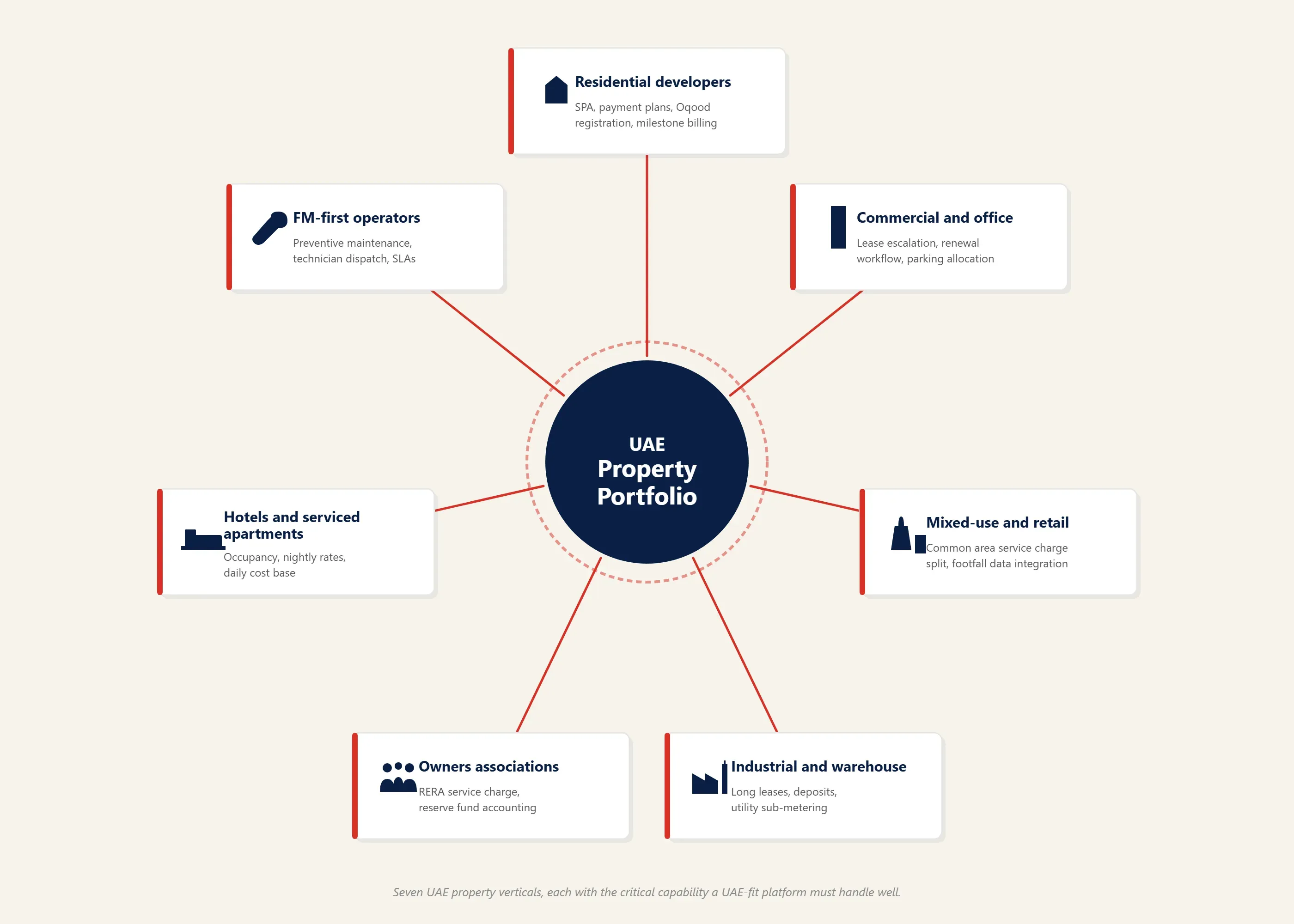
Vendors will claim fit for all seven. In practice the product's history tells you where it was really built. A platform that started as a residential CRM will treat a commercial lease as a residential tenancy with a different label. A platform that started as a hotel PMS will treat a long commercial lease as an unusually long reservation.
Ask the vendor what their first UAE customer did. If it does not match your vertical, you are not their primary case.
Questions worth asking before you shortlist
Every vendor positions well on paper. These are the questions that typically separate strong UAE fit from softer fit, framed as things to confirm rather than things to catch out:
- Mollak. Ask for a live screen-share of a Mollak submission end-to-end on anonymised data. Confirms depth beyond "Mollak-ready" messaging.
- VAT and Corporate Tax. Confirm how the platform treats commercial lease revenue, residential exemptions, and Corporate Tax-aligned revenue recognition.
- PINT AE e-invoicing. Ask for the published phase-by-phase roadmap. A clear plan is a good signal; a vague "we are compliant" usually means the work is still ahead.
- Support model. Confirm whether UAE support is in-house or reseller-delivered, who the named implementation consultant would be, and where they are based.
- Pricing. Clarify whether pricing is per unit, per module, or per user, so year-three cost is predictable as you scale.
- Demo data. A demo on your own anonymised dataset is more informative than one on the vendor's standard dummy data. Most vendors will do this if you ask.
- References. Ask for UAE reference customers in your vertical, your emirate, and your portfolio size. One or two solid references in your shape beats five generic ones.
- Implementation timeline. Three to six months for a mid-market deployment is realistic. Shorter timelines usually mean license go-live, not business readiness; longer timelines usually reflect legacy data complexity.
- Product roadmap. A visible release cadence (quarterly or semi-annual) is a stronger signal than "we release when customers ask."
None of these are deal-breakers in isolation. Taken together, they tell you quickly which vendors will still be a fit for your business in year three.
Implementation realities: what to budget beyond the license
License is the smaller line item. The invisible costs are:
- Data migration (15 to 25 percent of year-one investment). Legacy lease data, tenant data, cheque data, and historical ledgers must be cleaned, mapped, and loaded. The quality of your legacy data decides the cost.
- Configuration versus customization. Configuration (switches, parameters, workflow setup) is included in most implementations. Customization (new modules, non-standard reports, API integrations with your bank or portal) is extra. Know the line before signing.
- Mollak and Ejari backfill. If you have been off-system, bringing historical tenancy and service charge records up to date on the new platform is a defined project of its own, usually one to three months.
- Training. Superuser-first, then rollout. A fast rollout to all users on day one usually produces a slow abandonment to spreadsheets by month three.
- Cheque book migration. Legacy ledger PDCs must be migrated with their presentation schedule intact. Done wrong, this produces double-presentation and bank-level pain.
- Realistic timeline. Three to six months for a mid-market portfolio. Twelve months for a large multi-entity operator. Anyone quoting weeks is quoting license go-live, not business readiness.
Budget a 1.3x to 1.6x multiplier on vendor-quoted year-one investment to account for the above. If the vendor's quote already includes these line items transparently, that is a strong signal in their favour.
Why we built Horizon EBS for Real Estate
Horizon EBS has served UAE real estate operators for 35 years, since 1991. We built it as a full ERP, not a property management point tool, because the UAE market needs leasing, finance, FM, HR, procurement, and assets under one data model. Mollak, Ejari, DLD connectivity, VAT, PDC management, Corporate Tax readiness, and PINT AE e-invoicing are core modules, not partner integrations. The platform runs across developers, property managers, mixed-use operators, owners associations, and facility management companies, with mobile apps for tenants, field technicians, and managers. If you have been reading this guide and the seven criteria match what you need, the next step is to see Horizon EBS running on a dataset shaped like yours.
Next steps for UAE operators evaluating property software today
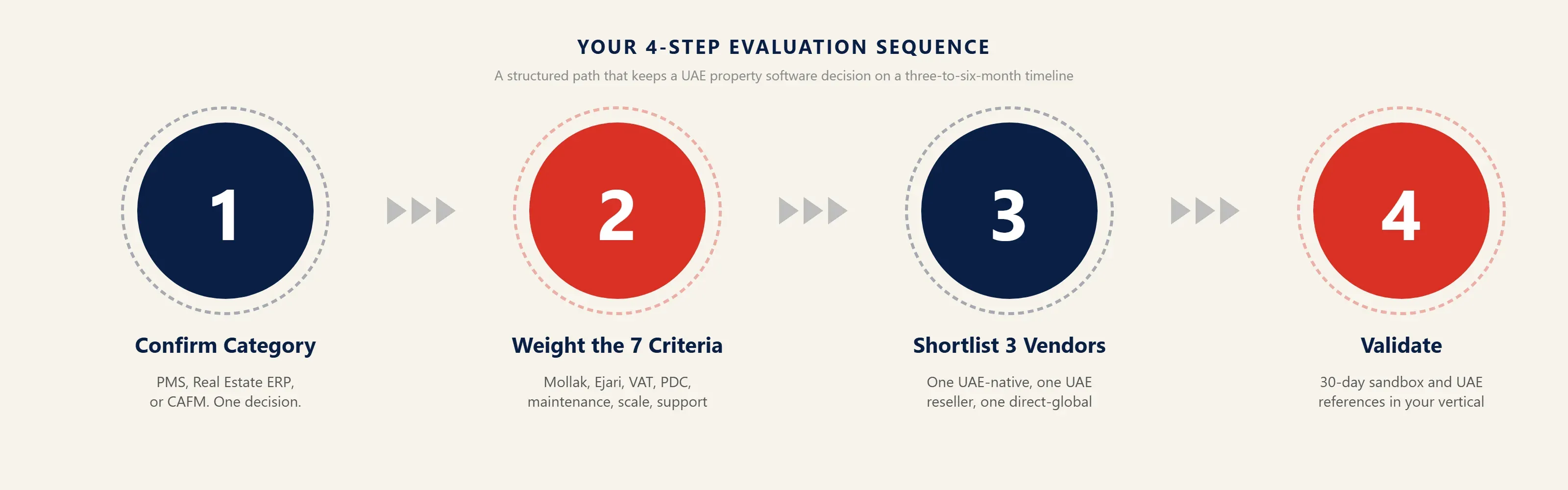
The decision does not have to take six months. A structured sequence:
- Confirm your category. PMS, real estate ERP, or CAFM. The three-column table above decides it.
- Define your seven criteria weights. Not every operator ranks Mollak depth equally. An FM-first operator weights preventive maintenance higher. A developer weights SPA tracking higher.
- Shortlist three vendors. One UAE-native, one UAE-leading reseller of a global product, one direct-global if you want to pressure-test. Three is the right number.
- Involve finance, FM, leasing, and legal in the demos. The leasing team cannot sign off on an ERP alone.
- Ask for UAE reference customers in your vertical and emirate. Not US references, not UK references.
- Validate with a 30-day sandbox if the vendor offers one. If they do not, understand why.
- Budget AED range per the implementation reality above (1.3x to 1.6x of license).
The right platform is the one your team will still be using in year five, not the one that demos best in week two.